
"Vibe testing" LLMs for customer research is risky: Researchers are learning the hard way
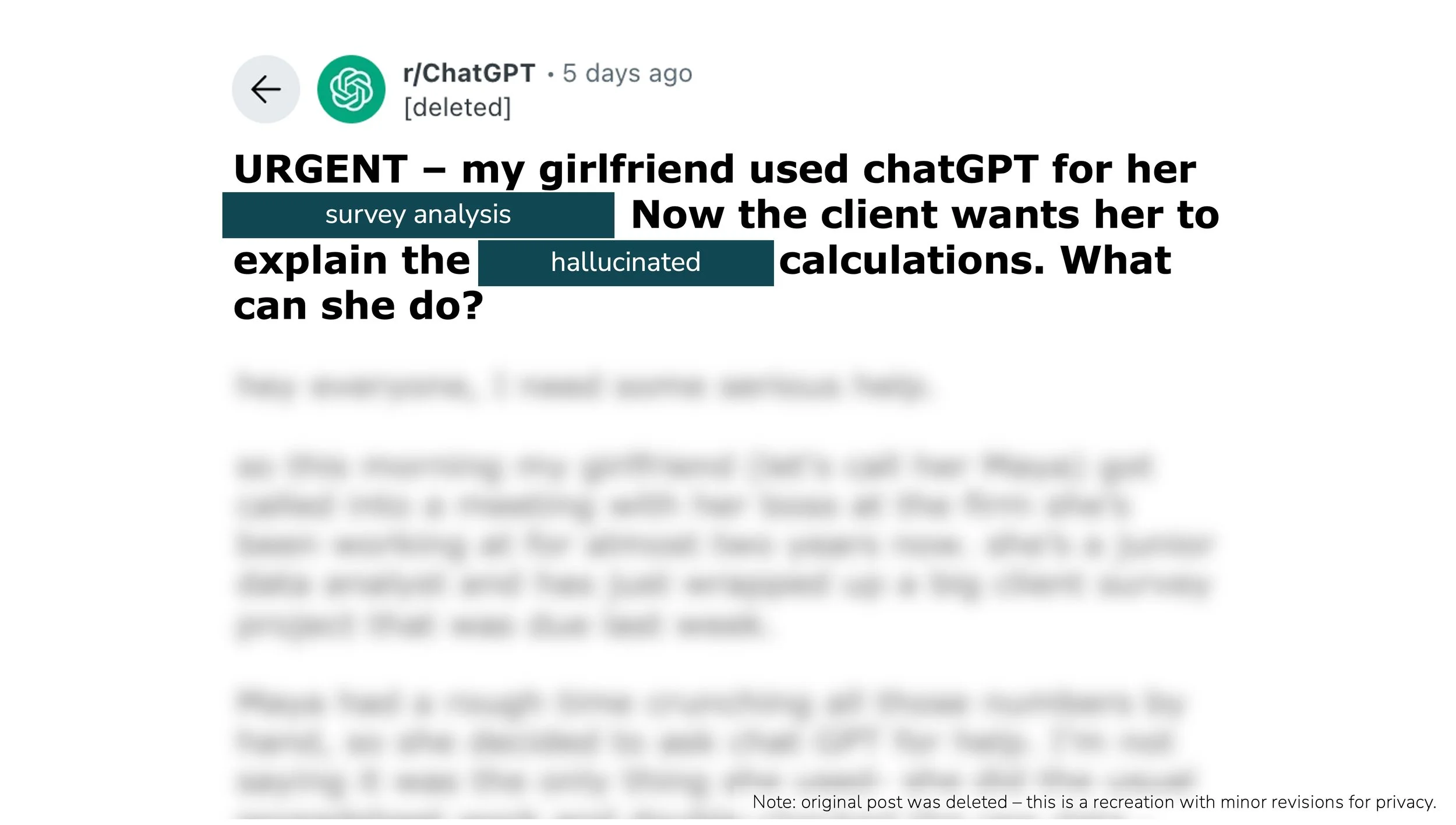
Seen last week on social media: a market researcher trying to save their job after reporting a nonsense, LLM-generated analysis of survey data.
The client flagged it, and it became a major headache for everyone involved: the researcher, the researcher’s boss, and the client who’s wondering why they paid for human insight and got handed AI hallucinations.
Per the (now-deleted) post, the researcher had no idea their AI process was risky. They’d dumped data into ChatGPT before, and the results always looked reasonable.
This highlights the problems with “vibe testing” LLMs for research applications.
Because if you’re not following a rigorous process, all your output may look great–until it isn’t.
I feel for the researcher in this post, because it’s a common mistake to make, especially if you’re used to small samples and qualitative analysis. Generative AI works differently from traditional software, but there’s hardly any training for researchers on how to understand and account for these differences.
This is why we do 30+ runs to evaluate LLMs in my research training workshops. Because with more runs, you can better recognize the range of potential errors–including less frequent ones like this, where the LLM made up a statistical analysis that couldn’t actually be done.
Fortunately, you can retrain your instincts about assessing AI output (even if you’ve only ever done qualitative analysis). I’ll be showing you how in two upcoming workshops:
If you’re trying to use AI research tools more effectively →
👩🔬 AI for UX Researchers (October, Rosenfeld Media - register here)
If you’re building AI products →
👩💻 User research for AI-enabled products (November, email me for info!)
I'd love to see you there.